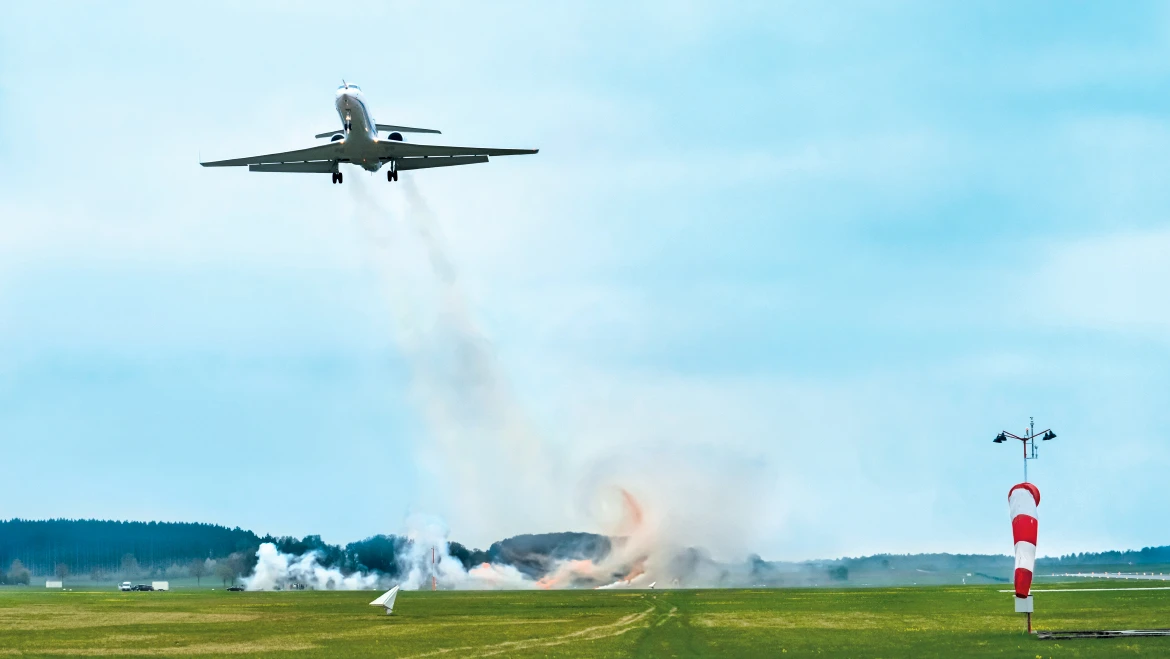
Tests show that plates installed at the end of runways help dangerous wake turbulence from previous aircraft to decay much more quickly.
Mitigating wake turbulence to increase airport capacity
They still look a bit like they’ve come straight from a brainstorming session in the workshop: dark-green tarps pulled tightly over wooden frames, measuring nine meters long by four meters high. Hinges have been integrated on the underside so that the boards can be raised, all in a row, over a fixed base in the ground. Tension lines hold them in position. Yet setting up what has been dubbed the “Plate Line” is anything but a game: once in place just in front of the runway, the configuration patented by the German Aerospace Center (DLR) can shorten the intervals of time between landing aircraft.
In the meantime, we can confidently state that the plates reduce the duration of long-lasting vortices by some 30 percent.
Dr. Frank Holzäpfel, DLR Institute for Atmospheric Physics, Cloud Physics and Transport Meteorology
Currently, small and midsized aircraft have to maintain a safe distance of some ten kilometers from heavier jets flying in front of them. The reason is wake turbulence, specifically vortices that roll over the aircraft’s wingtips where the low pressure above the wing meets the high pressure below it.
“Long-lasting vortices can be quite powerful,” explains Dr. Frank Holzäpfel from the DLR Institute for Atmospheric Physics, Cloud Physics and Transport Meteorology. “They can pose a real problem for any aircraft flying behind them.”
State-of-the-art test equipment
The danger arises mainly from the occasional tendency of the vortices to persist for some time right in the flight path of subsequent aircraft. They can even damage the ground and nearby buildings. Holzäpfel calculates that the vertical plates will cause the vortices to decay more quickly, and ideally even dissipate altogether. When the vortices meet the plates, they generate secondary vortices that counteract the initial ones. In other words, the vortices essentially cancel each other out.
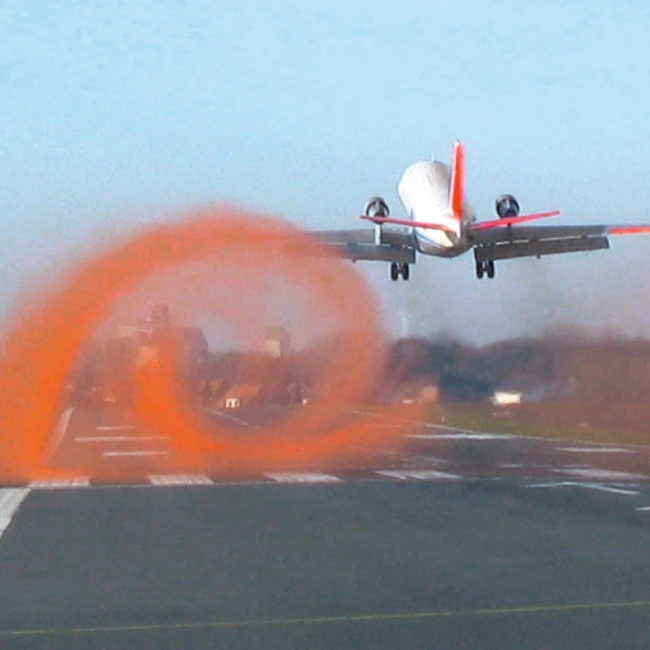

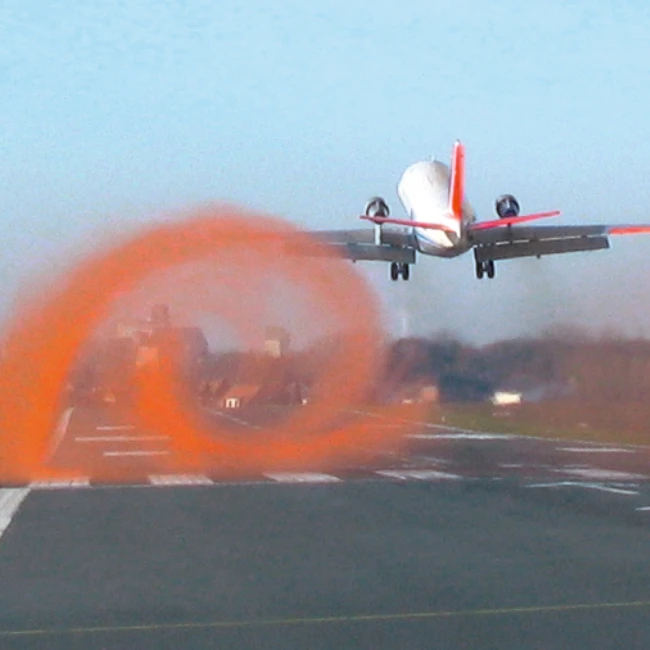
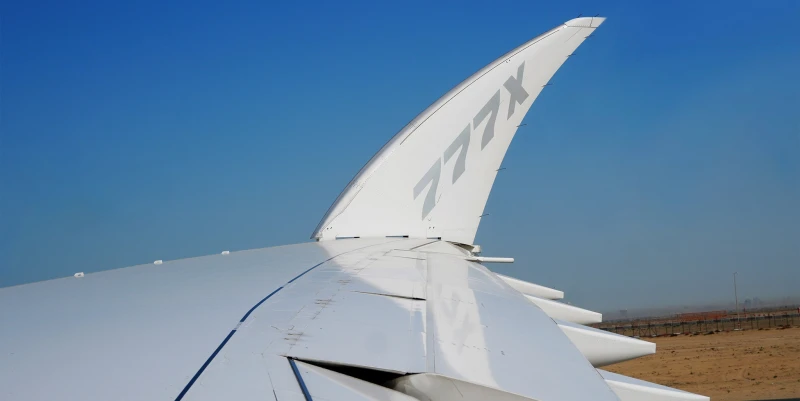
Dangerous wake turbulence: Vortices pose a real safety risk for any aircraft in the flight path behind.
Dangerous wake turbulence: Vortices pose a real safety risk for any aircraft in the flight path behind.
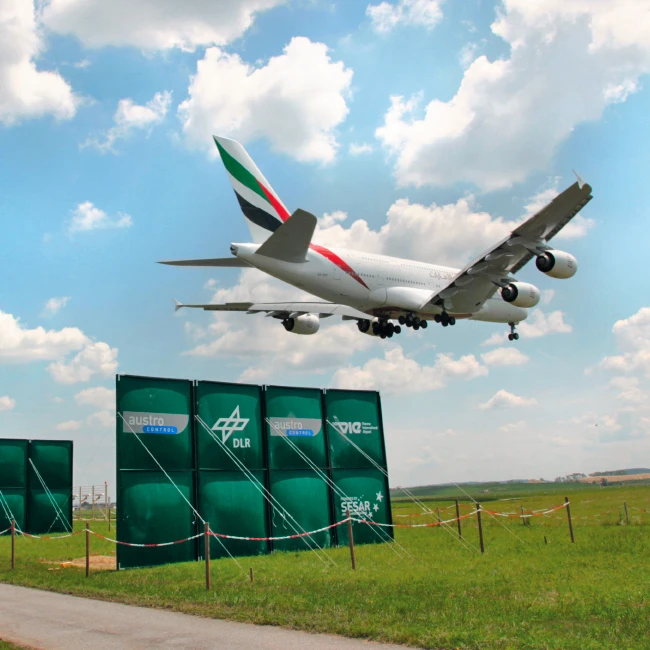
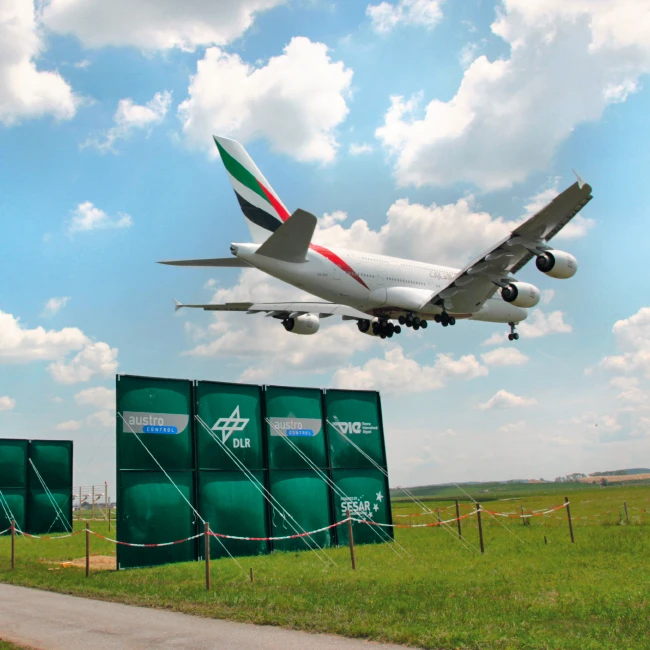
Plates vs. vortices: Measuring nine meters long and four meters tall, these plates essentially cancel out vortices – generated.
Plates vs. vortices: Measuring nine meters long and four meters tall, these plates essentially cancel out vortices – generated.
Holzäpfel and his colleagues have already been able to demonstrate the basic underlying relationship, using the water towing tank, flow simulations and a G550 research aircraft for initial flight testing at DLR’s Oberpfaffenhofen location. Now the DLR has teamed up with Austro Control, an Austrian air traffic control provider, and several other partners on a project entitled “Wake turbulence separation optimization.” Supported by EU research program SESAR, this collaboration aims to demonstrate the effectiveness of the plate configuration in live operation at Vienna International Airport.
To this end, the partners had state-of-the-art test equipment installed. For example, a novel cloud radar system, now being tested at an airport for the first time; it delivers deep insights into the wind direction and shearing in complex cloud and precipitation scenarios. A microwave radiometer provides a vertical temperature and humidity profile, and a wide range of other sensors monitor the setup. The equipment had to undergo an enormous approval process for the partners to get the permission they needed to install it all right in front of a runway.
But their efforts have clearly paid off. “Initial analysis of the measurement data shows that vortices near the plates do indeed dissipate more quickly,” Holzäpfel reports. “In the meantime, we can confidently state that the plates reduce the duration of long-lasting vortices by some 30 percent.”
Counter-rotating vortices: Vortices form when low pressure from above the wing and high pressure from below the wing collide. Generated primarily at the wingtips, the vortices then rotate outward in the shape of a corkscrew.
Opening the door to reduced landing intervals
That figure is staggering. “Very encouraging” is how Christian Kern, head of Air Traffic Management at Austro Control, describes it. “Should this figure be confirmed, the Plate Lines could improve safety at all airports for the next aircraft in line to land—and in a best-case scenario, boost capacity at those airports as well.” That’s because if the vortices vanish more quickly, approaching aircraft can land in more rapid succession. The method would also avoid expensive and time-consuming construction work for expanding the infrastructure.
All this of course depends quite heavily on the rules and regulations for aircraft landings, such as those issued by the European Union Aviation Safety Agency (EASA). Nevertheless, the validated effect of the plates would be a good basis for further considerations about reducing the intervals between aircraft landings.
For now, the DLR wants to take some time to further refine the plate combination of tarps, wooden frames and hinges. “We are already working on the specification and production of a permanent plate installation,” Holzäpfel says.