The Okavango Delta is an African natural paradise full of wild animals. Mack Air’s flight service here in the middle of the bush operates to the highest airline standards.
Botswana’s delta airline
©Andreas Spaeth
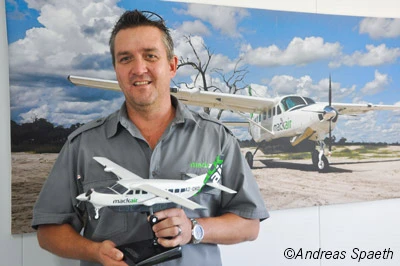
“There must be 35 of them here during the peak season from June to August, that’s when Maun becomes Africa’s second busiest airport by aircraft movements, after Johannesburg.”
Michael Weyl
Managing director of Mack Air
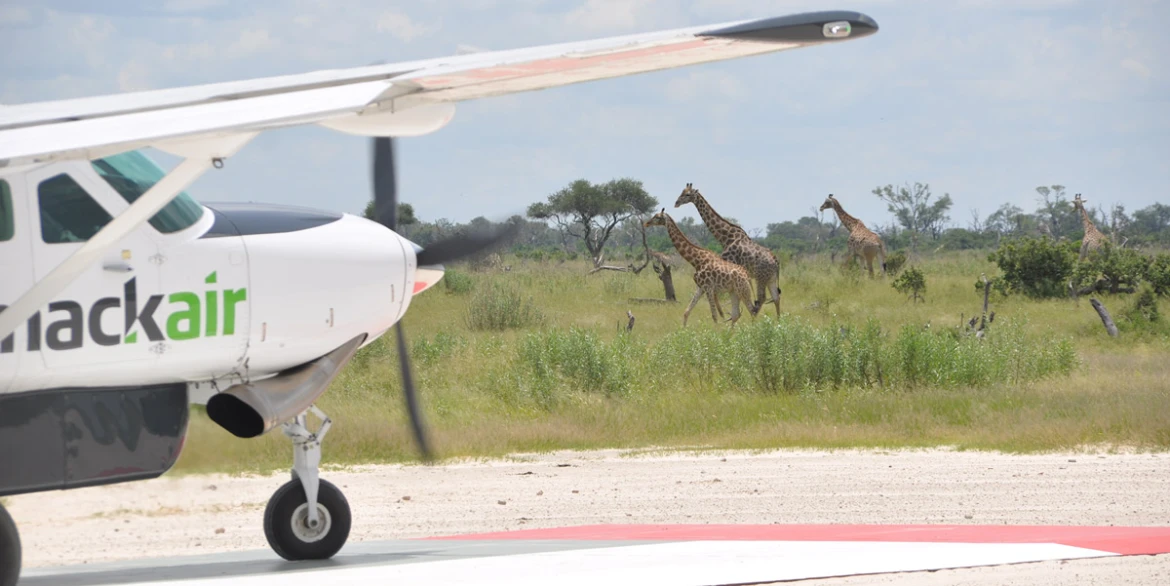
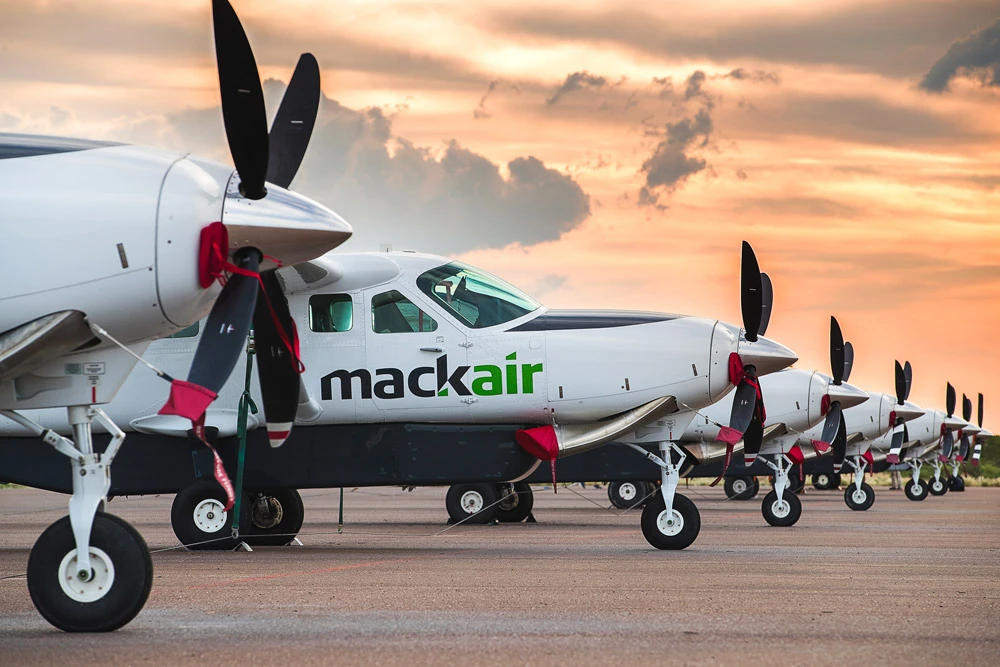
Tail to tail, they stand lined up in the African morning sun—Cessna Grand Caravan single-engine turboprop aircraft. The twelve-seaters are easily recognized by their long legs, which provide sufficient ground clearance for the powerful four-blade propellers at the front and enough space for the underbelly cargo pod for the passengers’ luggage. Nowhere in the world are there more Grand Caravans stationed than at Maun Airport in northwestern Botswana in southern Africa.
“There must be 35 of them here during the peak season from June to August,” says Michael Weyl, Managing Director of Mack Air. “That’s when Maun becomes Africa’s second busiest airport by aircraft movements, after Johannesburg.” Most of the time Maun seems rather sleepy, the dispersed town looking like a big village; to date, the only international service to the airport is from neighboring South Africa. In any case, almost all of the 240,000 or so passengers arriving here each year have just one thing in mind—to fly on to the Okavango Delta.
©Mack Air
Uniform fleet: Mack Air operates a fleet of 18 Cessna Grand Caravan EXs stationed at Maun Airport.
The Okavango Delta, a dream destination and a pilot’s dream job
One of Africa’s largest wetlands, the Delta is a natural paradise teeming with wild animals and a UNESCO World Heritage site. It’s a dream destination for many travelers—and flying here is a dream job for many pilots. By far the most important operator is Mack Air, the largest private airline in Botswana and the most modern in this category in all of Africa. In 2019, Mack Air flew just over 106,000 passengers to 51 bush strips in Botswana and 38 in Zimbabwe; recently it even started offering scheduled flights in the border area between the two countries, which attracts many tourists.
Without aircraft, everything in the Delta grinds to a halt—depending on the season, the majority of its 74 predominantly luxury lodges are at times accessible only by air, while four-wheel drive trucks struggle to bring in heavy supplies from Maun over rough tracks. All guests, staff and fresh produce arrive in a Mack Air Grand Caravan or courtesy of a lodge-owned air service. Founded in 1994, Mack Air now has a grand total of 18 of the latest Cessna Grand Caravan EXs.
Since 1984, this twelve-seater aircraft has built up a successful track record as a robust and roomy workhorse. It can optionally be equipped with wheels, floats, or often a combination of both; alternatively, it can be fitted with skis. The turboprop has an unpressurized cabin and can be operated either as a passenger or as a cargo aircraft. The largest customer for this aircraft is the courier service FedEx, which operates 234 of them in the Cargomaster version. Although only 3,000 Grand Caravans have been delivered worldwide, most recently in January 2023, these high-wing aircraft are particularly popular in Africa—especially for flights to remote regions and landings on unpaved bush airstrips.

©Andreas Spaeth
©Andreas Spaeth
©Andreas Spaeth
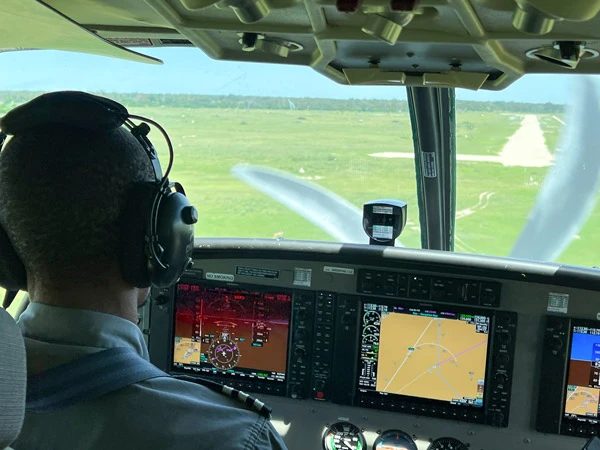
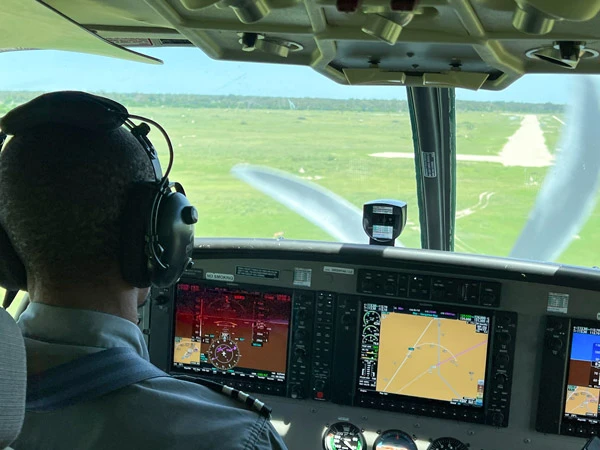
Glass cockpit in the bush: State-of-the-art technology in the cockpit helps the pilot approach short dirt runways in the Okavango Delta.
©Mack Air
©Mack Air
©Mack Air
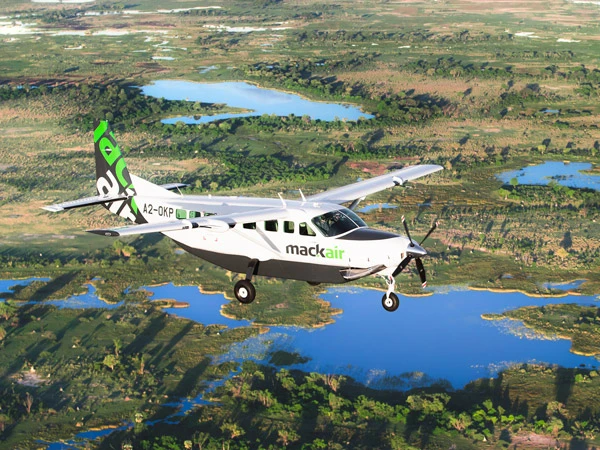
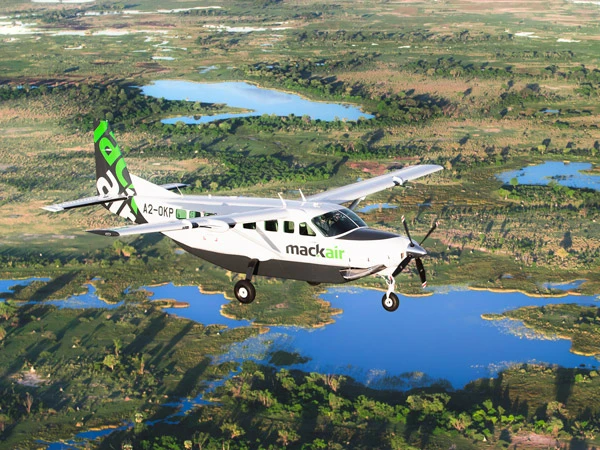
Delta panorama: A Mack Air Cessna Grand Caravan flying low over some of the many water holes in the Okavango Delta.
Higher climb rate with new engine
The latest EX variant has been offered for the past ten years and over 500 units have already been delivered. It features the Pratt & Whitney Canada PT6A-140 engine, which produces 867 hp (647 kW) and increases climb capability by 38 percent. The EX has a range of 1,785 km, but in Botswana this is needed only in exceptional cases for charter flights to South Africa; in the Delta, ten-minute hops are more common. With its full payload of over one metric ton, the aircraft needs a 660-meter runway for takeoff and can land on 570 meters. Airstrips in the Delta are quite short at one kilometer.
“To me, the Caravan is the perfect bush plane,” says Paul Murdock, a veteran pilot with Mack Air. The 61-year-old New Zealander has spent over 2,000 hours at the controls, sometimes alone and sometimes with a copilot; the Caravan is certified for single-pilot operations. These days, Murdock flies in the right-hand seat, putting Botswanan pilots at Mack Air through their paces before they are allowed to fly solo. “The Caravan is perfect for the type of airfields we serve. Its high wings give us a good field of vision. And thanks to its more powerful 1.4-ton engine, the EX can also carry more cargo.”
Solo flights only after 800 flight hours
Flying the Grand Caravan EX with its glass cockpit is one thing, but doing it every day over many short distances in the middle of the African wilderness is quite another challenge. That’s why local pilots straight out of flight school must have completed at least 800 flight hours and have to fly with an instructor initially before being allowed to pilot the aircraft on their own. “Pilots who don’t come up to our standards won’t make it into the cockpit. They have to meet our criteria, and that means they have to be pretty outstanding,” Murdock says.
Within a radius of just 50 nautical miles (92 kilometers), there are about 30 airfields in the Delta, which stretches 250 kilometers by 150 kilometers, with each strip usually serving two or three lodges. “This is hands-on flying,” says Mack Air chief pilot Tafadzwa Mugoni. “Very short sectors, a fast turnaround, we don’t even turn off the engine after most landings. That really helps you expand your flying skills. What’s incredible is how many animals there are: you’re always on safari here, and you’ll often tick off the Big Five on one flight even before your first landing.”
©Andreas Spaeth
©Andreas Spaeth
©Andreas Spaeth
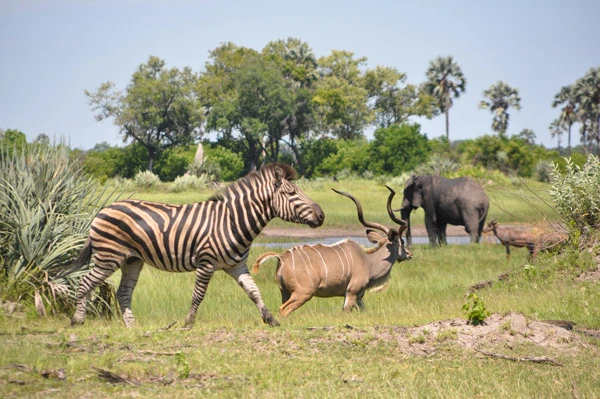
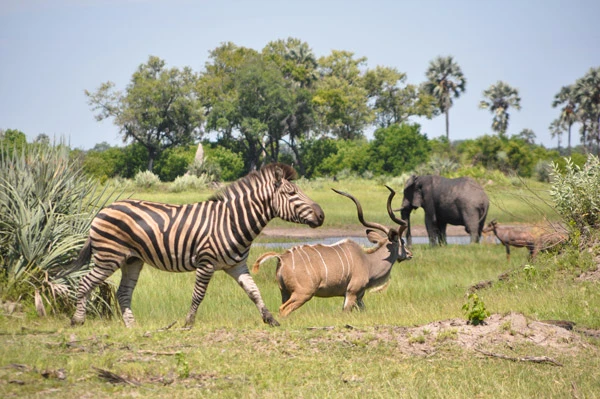
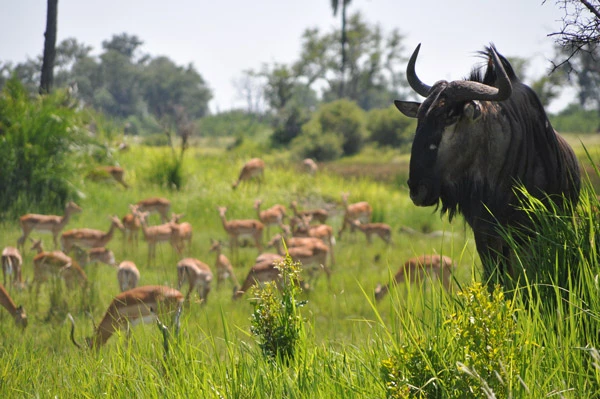
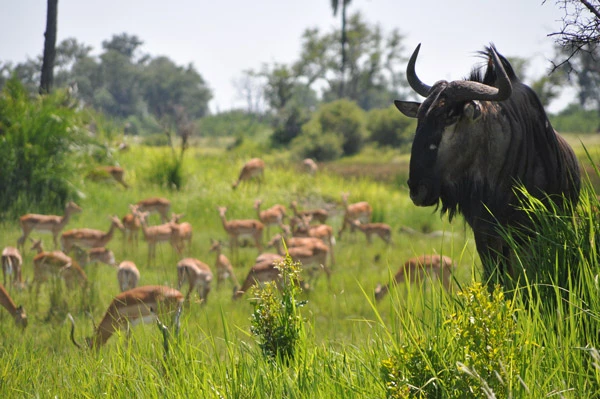
African adventure: Antelopes, zebras, elephants—the variety of animals living in the Okavango Delta is greater than almost anywhere else in Africa.
©Andreas Spaeth
©Andreas Spaeth
©Andreas Spaeth
Wild kingdom: A gnu looks at a herd of impala antelopes—the sheer size of the herds is a special feature of the Okavango Delta.
PT6 – the all-around talent
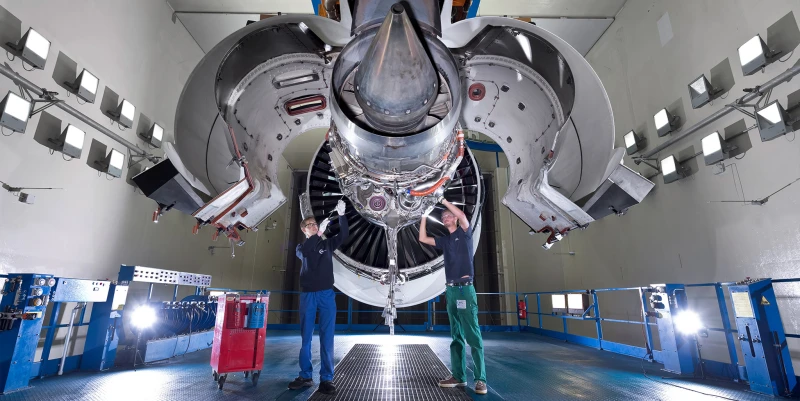
An aviation classic, the Pratt & Whitney Canada PT6 turboprop engine first flew in 1961. It is available in different sizes for applications ranging from single-engine sports aircraft to helicopters. The largest variant of the PT6A is for heavier twin-engine aircraft like the Cessna Grand Caravan EX or the Short 360 regional commuter airliner. Approximately 12,000 of these large PT6A engines are around today, and it is estimated that, counting all variants, some 55,000 PT6 engines have been built to date.
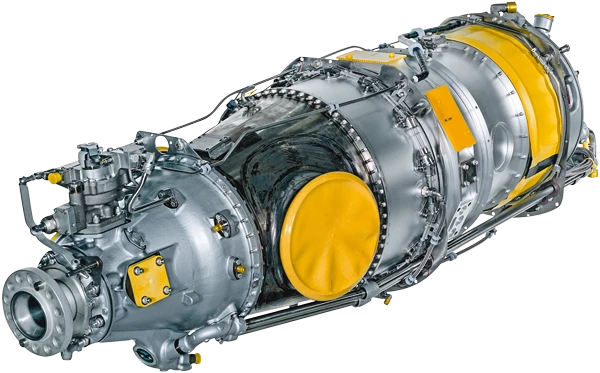
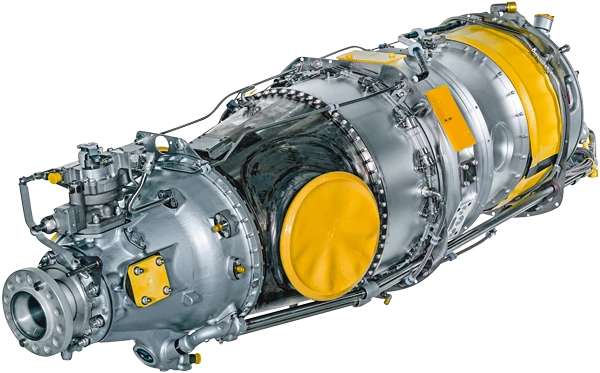
Guarantee of success: The PT6A engine family is the world’s most popular engine in its class. The experience acquired with the PT6A played a part in the creation of many other Pratt & Whitney engine families.
“The animals roam free here, we’re just visitors”
All the pilots in Maun have incredible wildlife stories to tell; nowhere else do aviation, lions, leopards and other wild animals regularly come as close to one another as in the Okavango Delta. “I was on final approach and suddenly I saw a pride of five lions lying right at the edge of the runway I was about to touch down on,” says Samantha Steel. The 35-year-old pilot from South Africa initially opted for a low pass, but it didn’t have the effect she was hoping for. “The lions had just eaten, they had big bellies and were so lethargic they wouldn’t move,” she recalls.
“I ended up landing anyway, and our planes aren’t quiet, but the lions didn’t shift an inch: they just don’t care, they’re used to aircraft noise,” Steel says. And landing strips in the bush have different priorities than airports. “The animals roam free here,” she points out. “We’re just visitors. That’s a huge challenge for us as pilots. The landing strips are short, there are animals everywhere, and we have a lot of near misses.”
Stubborn ostriches, ravenous hyenas
Steel also knows a thing or two about notoriously stubborn ostriches that almost as a general rule are unwilling to budge from an airfield. And about ravenous hyenas that decide to use the landing strip as a dining table on which to devour their recently killed prey—just when the Cessna Caravan is scheduled to land. “That’s when I had to abort the approach three times and perform a go-around,” she says. Her colleague Murdock remembers a rhino that wouldn’t allow itself to be driven off the airstrip for three months. “If you try to do it with a car, the animals think it’s a challenge and ram you, so we’ve ended up in some hairy situations that way.”
In spite of all that, the pilots here feel they are in good hands: “Things used to be a lot more relaxed, to be sure,” Murdock says, “but it’s fine, things are much safer now than they were. We’ve eliminated all possible risks.” And in any case, no pilot wants to miss out on the endless thrill of seeing what wildlife whimsy awaits their next landing in the Delta.